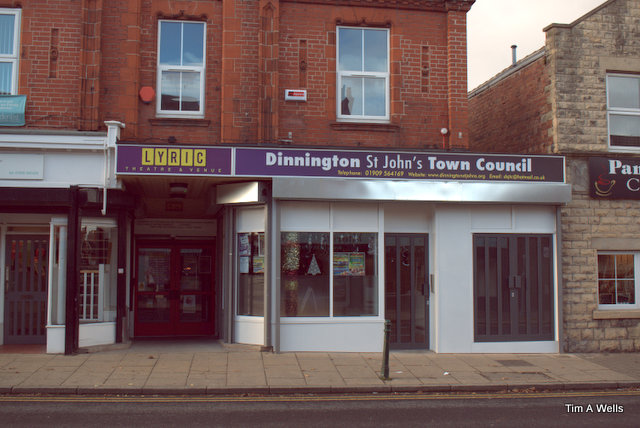
The Lyric was built in 1910, its main originator was Mr James England, a local entrepreneur and impresario. His son Fergus was credited with doing a large part of the building work.
The Lyric was built exclusively as a theatre with a stage, proscenium arch, dressing rooms, a fly tower and with operating balconies for the stagehands on three sides. Strangely enough the original Lyric was built without back stage toilets, but there were later added.
People not familiar with Dinnington have always found the theatre hard to find, its tunnel like entrance hid between two shops always made finding the entrance difficult. For many years Fred Ranstall ran a men’s shop on the right-hand side and Melia’s had a grocery shop to the other. The grocery shop, believe it or not used to be a roller skating rink, a pastime that had become very popular at the time.
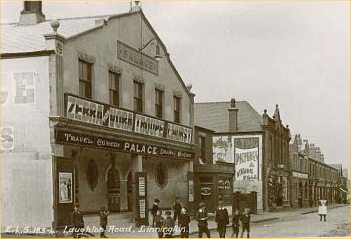

The Lyric started out showing silent films, mainly from the Western genre, from a projection box only reached by a ladder, before James England would later go on to building the Palace Cinema just a few doors up in 1915.
As the Palace Cinema went from strength to strength the Lyric became best known as a music hall, with shows usually running for six nights with a matinee on a Tuesday morning that catered for men on the afternoon shifts.
Dinnington is one of the very few places that managed to maintain a cinema and a music hall before, during and after the First World War. Over the years the Lyric has enjoyed some very prosperous times, but these have also been coupled with lean times. But the place always remained as the number one dance hall in the area which did a lot to carry it through the rougher periods.
In 1938, Mr. Francis Davies who was the new manager of Dinnington Colliery resurrected the operatic society and was instrumental in the formation of the dramatic society. He was a lover of Gilbert & Sullivan operas and with this the new society began a series of Savoy operas beginning with the “Gondoliers”.
In 1962 the Lyric changed hands, purchased by the parish council for the sum of £1800. This was considered a bargain price but mainly because the place had become a liability to the owner and was in dire need of revamping.
Many organisations are now using the Lyric, it is probably as busy now as at any point in it’s history. It’s image as a music hall has been upheld by the Operatic Society and the Theatre Club. The Theatre Club shows much enthusiasm and confidence in bringing to the Lyric many well-known artists who give great pleasure to large audiences.
The Lyric will continue to thrive in this village and remain the number one venue in the area.
What became of the Palace Theatre? A supermarket!
Enjoy your next visit.